Car industry demand by demographics
MJMcCann-Consulting

Fleet Demographics as the underlying dynamic driver.
Here's an example of an independent consultant looking at underlying causes instead of statistical projections to deal with micro-economics.
In the UK, after the second world war, the few motor cars that had been laid up during the war came back onto the roads and joined a similar number that had
continued in use, making a fleet of about 1.5 million passenger cars.
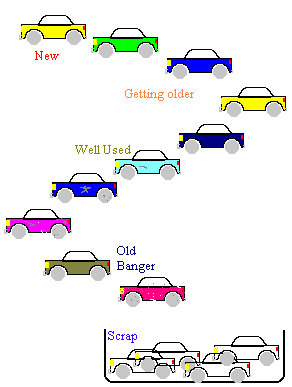 In the early seventies, the fleet was nearly ten times the size, the motor industry was a big economic sector and its future growth and development was a matter of great concern. We looked at the growth of the fleet since 1935. Since there is good data on things that are taxed, we were able to identify the number of new vehicles each year, the size of the fleet at any time and, by cumulative difference, the rate at which vehicles were scrapped. By a little more analysis, we were able to make an estimate of the median age of the scrapped vehicles.
After trying to examine the movement in ownership from new to used and the influence that might have had on the demand for new cars, we realised that each operating car satisfied someone's transport demand. Furthermore, the cars do not spend a significant part of their life in the used car lots. Our dynamic model of the market then took in the historically known new additions, allowed them to age over the years and scrapped them at roughly the appropriate age. That was a fair imitation of what was known to have happened and it allowed us to see the extent to which the market was for new additions to the fleet and to what extent it was a for replacements. On our estimates, the UK market moved to being predominantly a replacement market in the early seventies.
The age for scrapping had substantially stabilised by the early seventies, so we could project the forthcoming scrapping rates from the historical new car data and see what was coming from that source of demand. Realising that there was an equilibrium model of roughly one car per licenced driver (from the USA) we looked at the UK in the light of one per household and estimated a proportion for the approach to that to match the observed growth in the fleet. The model could then be run out into the future to make a forecast. The historical periods of big demand were echoed into the model future by the scrapping of those old cars, the fleet gradually approached its equilibrium taking
decades to do so and in the process we could see what the motor industry would be doing.
The model also illuminated some threats for the future. Applying the idea to different countries we could see that the manufacturing capabilities of Europe could sustain its long term needs but the Japanese motor industry was grossly out of proportion to its future domestic needs. It was going to be a forceful exporter. History has shown how true that was.
Other Experience
My experience with problems over these time scales is that people rarely expand their time horizons far enough to see the whole picture. Even if they try, they tend to miss interaction effects and think more in terms of extrapolating, sometimes with statistical models, from the recent past. My (MJMcC) observation is that the demographics and the compelling force of reality can be quantified to make a big improvement in perception. You only have to
contact me to get help!
Home/Index Page
About Dr McCann
Summary
Dr M.J.McCann
Training Courses
Bristol University
Contacting me
Contact in UK
Location USA
Philosophy
Software Tools
Fees
Confidentiality
 Applications
Business & Commerce
TV Advertising
Drugs Competition
Housing Demand
Automobiles Demand
Wallcoverings Battle
Cash Flow
Human Resources
Project Management
Patent Analysis
Chemical Industry
Cooling Tower
Fermentation
Polymer Process
Heat exchange
Supercritical Fluid
Distributed parameter
Toxic gas allocation
Electrical
Control systems
Initiation systems
Ferrite Filters
Microstrip Antennas
Lightning
Production & Process
Automated manufacture
Crimp and Press
Glass making
Glass molding
Glass to metal seals
Heat exchanger
Helium Leak Testing
RF Soldering
Vacuum web coating
If you have a problem with the behaviour of a market sector, plant, process or item of equipment and would like to get a quantitative handle on it to improve yield or optimise performance, then contact me. I'm always ready to give a little time to discuss a new puzzle, in confidence, of course. We'll only worry about fees when there is some defined work. I can be flexible about how I work with you.
Top
POB 902,
Chadds Ford PA
19317 USA.
T: 1 302 654-2953
M: 1 302 377-1508 (Cell)
E: mjmccann@ieee.org
File:automobi.htm