Dynamics of heating and cooling of graphite carriers & contents in reducing atmosphere
MJMcCann Consulting

The Process.
In a process of making glass to metal seals, the components are assembled
with the glass in the form of small items (rings in this case) placed in or around the
metal parts. The components go through a furnace where the intention is to let the glass
soften just sufficiently that it flows gently into place, making a good seal to the
metal.
It is important that the glass doesn't become too runny, nor stay too stiff. To
make a lot of little parts at once, a carrier may be used that takes them through the
furnace (or lehr). 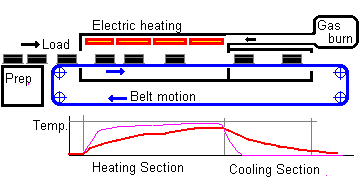 Frequently the process will be almost continuous in that the
carriers move on a belt through the furnace and are subjected to a gradually changing
temperature as they pass. If all goes well, the temperature reached by the crucial glass
bits and the adjacent metal will be just right to let the glass slump into place.
Frequently the process will be almost continuous in that the
carriers move on a belt through the furnace and are subjected to a gradually changing
temperature as they pass. If all goes well, the temperature reached by the crucial glass
bits and the adjacent metal will be just right to let the glass slump into place.
Graphite Carriers
The carriers are made of graphite which will stand the high temperatures, but only if there is
no oxygen left in the air where they are hot, otherwise they would burn up. The gas burner
therefore feeds air with no oxygen left in it to the heating zone where electrical heat
does the rest of the job of controlling temperature.
A Simulation
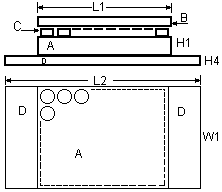
The mathematical model I made for this was a set of differential equations for
subregions of the carrier, subjected to an incident environmental temperature which we had
found by measuring the temperature of a thermocouple passed along the belt (which was
then stopped before the thermocouple leads snapped).
Within the graphite carrier, I modelled the heat transfer into the parts and
thus established the temperature of the glass and metal materials as a function of time
(related to distance by the belt speed).
Glass Viscosity Effect
By calculating the viscosity of the glass and using that as a measure of how runny
it had become we were able to see the crucial point at which it softened enough to flow
and then see how changes in the temperature profile affected the potential for movement,
related to reciprocal viscosity.
Home/Index Page
About Dr McCann
Summary
Dr M.J.McCann
Training Courses
Bristol University
Contacting me
Contact in UK
Location USA
Philosophy
Software Tools
Fees
Confidentiality
 Applications
Business & Commerce
TV Advertising
Drugs Competition
Housing Demand
Automobiles Demand
Wallcoverings Battle
Cash Flow
Human Resources
Project Management
Patent Analysis
Chemical Industry
Cooling Tower
Fermentation
Polymer Process
Heat exchange
Supercritical Fluid
Distributed parameter
Toxic gas allocation
Electrical
Control systems
Initiation systems
Ferrite Filters
Microstrip Antennas
Lightning
Production & Process
Automated manufacture
Crimp and Press
Glass making
Glass molding
Glass to metal seals
Heat exchanger
Helium Leak Testing
RF Soldering
Vacuum web coating
If you have a problem with the behaviour of a market sector, plant, process or item of equipment and would like to get a quantitative handle on it to improve yield or optimise performance, then contact me. I'm always ready to give a little time to discuss a new puzzle, in confidence, of course. We'll only worry about fees when there is some defined work. I can be flexible about how I work with you.
Top
POB 902,
Chadds Ford PA
19317 USA.
T: 1 302 654-2953
M: 1 302 377-1508 (Cell)
E: mjmccann@ieee.org
File: Lehr.htm