Digitised Analogue Computer brings back hot wiring!
MJMcCann Consulting

I started in simulation with work on analogue (analog)
computers. They provided a natural link between continuous (mostly) physical systems and their dynamic simulations. The block diagrams that represented the analogue configuration had, naturally, the same topology as the diagrams showing cause-effect relationships in the prototype.
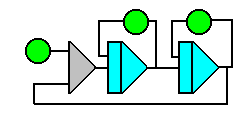 As a result, component parts of the electronic hardware (integrators, summers, potentiometers) of the model and their real world counterparts were easily linked in the minds of the users in a way that the underlying differential equations that they shared did not. It was a very natural way for engineers to do simulation of dynamic systems which is not now widely used. Though the tools like Simulink (MATLAB) provide a powerful, if expensive, replacement
In the middle '60's and early '70's digital computers became capable of matching computational speed in numerical solution of differential equations. A range of digital analog simulators appeared (DAS, MIDAS, CIDAS) which could be given block diagrams as net lists and imitate the analogue machines. It then became apparent that the interpretive block structured form was inefficient and statement structured simulation tools (CSMP, CSSL, ACSL) appeared that took advantage of compilation to create faster code. On the way the ability to point at a bit of the simulation and recognise it as a replica of some real world component, to stick a voltmeter in and read the value of the relevant variable, to flip switches and hot wire the model as it was running all vanished. We did get away from scaling problems, so it wasn't all bad news! Things like flight simulators with really heavy computational loads hung on a bit longer, but virtually all are now digital.
Computational Nostalgia.
With personal computers being faster now and graphical user interfaces much easier to create, I made a digitised analogue computer (McSimAPN) which recovers much of the diagramatic, visual and recognisable topology features of analogue computers to give an easy way to build a model by pointing and linking.
It runs like its analogue counterpart, press buttons (with mouse) stop, start, save results. But like all the digital differential equation solvers, scaling is no longer a problem, no one needs to get hurt by the 300 volt power supplies and you don't have to worry about wires coming out of patch panels or tweaking 10-turn potentiometers to set values. Models are stored in text files and can be restarted from where they left off.
Data can be saved in text files, parsable into spreadsheets.
While it was originally done for fun, I have solved real problems with it,
taking advantage of being able to play with a "live" model instead of having to
complete a run through a calculation before reviewing results.
Hybrid Computer Simulation.
Having made the analogue computer replica, I extended it so that it will do some of the things that HYBRID (analogue-digital) computers used to do.
The extension is to link a scriptable Microsoft Excel spreadsheet tool into the simulator so that users can exploit its VBA macro capabilities to build programmable functions into the otherwise 'analogue' models. We have used it for modelling PLC and SLC control of processes.
Discrete Event Models too
I also made a discrete event simulator using Petri Net ideas which also has, by its nature, a block diagram form.
Now the two simulators are built into one. McSimAPN, (Analogue-PetriNet, free download, <1MB, includes help files etc., no installation needed, runs under Microsoft Windows up to 8.1)
Other Simulation Tools
There are, of course many other mathematical modelling and simulation tools available. Matlab with Simulink provides a very powerful analog computer like environment, but doesn't merge the discrete event PetriNet form in. Various open source or free alternatives exist as well. My favourite, Mathcad provides a fine tool for producing mathematical models that are written in normal mathematical notation, thus being readily understood without learning a new programming language, but no analogue computer diagramming.
If you want to make a simulator for a plant, process or item of equipment and want both a good quantitative model and something pictorial that you can use for education, operator training, improving yield or optimising performance, then contact me. There's no charge for finding out that I can help.
Home/Index Page
About Dr McCann
Summary
Dr M.J.McCann
Training Courses
Bristol University
Contacting me
Contact in UK
Location USA
Philosophy
Software Tools
Fees
Confidentiality
 Applications
Business & Commerce
TV Advertising
Drugs Competition
Housing Demand
Automobiles Demand
Wallcoverings Battle
Cash Flow
Human Resources
Project Management
Patent Analysis
Chemical Industry
Cooling Tower
Fermentation
Polymer Process
Heat exchange
Supercritical Fluid
Distributed parameter
Toxic gas allocation
Electrical
Control systems
Initiation systems
Ferrite Filters
Microstrip Antennas
Lightning
Production & Process
Automated manufacture
Crimp and Press
Glass making
Glass molding
Glass to metal seals
Heat exchanger
Helium Leak Testing
RF Soldering
Vacuum web coating
If you have a problem with the behaviour of a market sector, plant, process or item of equipment and would like to get a quantitative handle on it to improve yield or optimise performance, then contact me. I'm always ready to give a little time to discuss a new puzzle, in confidence, of course. We'll only worry about fees when there is some defined work. I can be flexible about how I work with you.
Top
POB 902,
Chadds Ford PA
19317 USA.
T: 1 302 654-2953
M: 1 302 377-1508 (Cell)
E: mjmccann@ieee.org
File: analog.htm